
Landslide and Flood in Rasuwa Caused by Snow-Rock Collapse, Not Pure Glacial Lake Outburst
english.ratopati.com · Thu Aug 27 12:45:31 GMT 2026
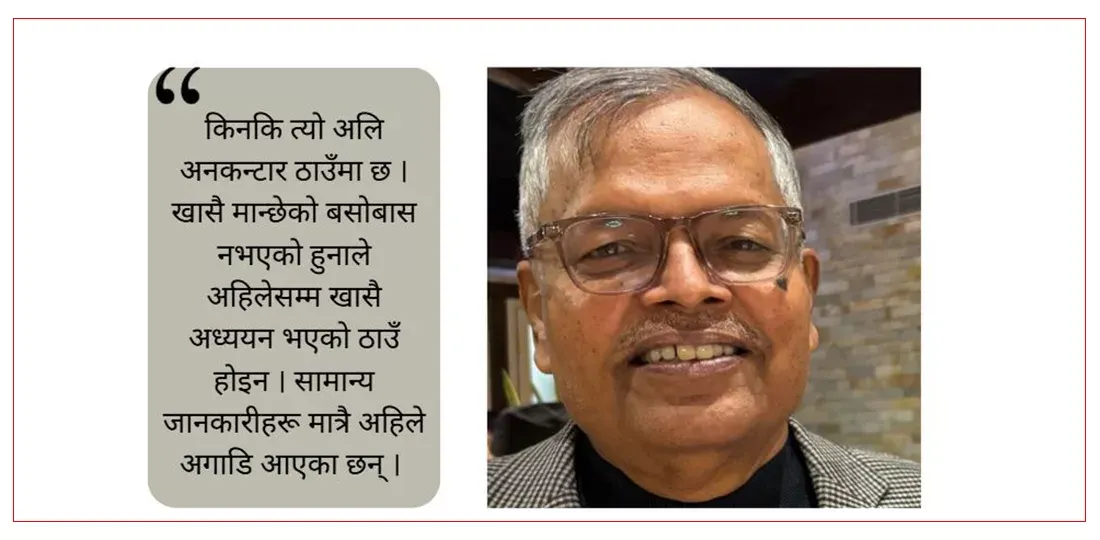
The truth about the flood that came through Rasuwa from Tibet on Wednesday, causing damage to Nuwakot, Dhading, and Chitwan, has not yet come out. According to the information received so far, a snow-rock collapsed quite high above Rasuwa, in a place where there was also a glacier. The rock with the glacier collapsed along with the glacier, and a wave emerged from there and flowed down all at once. As it flowed, it reached one or two small lakes above the Lande River. This blocked the river's water, and the lake water mixed with it and overflowed. By the time it reached there, the snow that came from above had already melted. By the time it reached the market, the snow had completely melted. All of this happened at once, and it brought a large volume of water into the river. This is the understanding so far. Research is being done on this because it is in a rather remote area. Since there is not much human settlement, it has not been a place of much study. Only general information has come out so far. People are speaking based on the videos that are coming out. Upon reaching there and looking, they say that the glacial lake did not burst. It has affected the glacial lake, and water has come from there too, but it is not purely a glacial lake burst. The biggest reason for this appears to be the snow-rock falling and the collapse of both the glacier and the rock. They have also exchanged photos showing a long stretch of rock falling, which is said to be the cause. Some are also attributing it to Nepal's lack of preparedness, but even with preparedness, there would have been little that could be done in the event that just occurred, because the flood came suddenly. Moreover, it is difficult to have prior information about a glacier collapsing like this. If we had been monitoring the drying up of glacial water, we might have been able to find something out. If we had been observing the increase in the size of glaciers every year or every six months, we might have been able to monitor it a bit and predict its possibility. But the sudden collapse of a glacier like this is very difficult. It is also difficult to monitor in such a remote area. It is not an easy matter for an early warning system. In the past, different types of incidents have occurred in Nepal. Last year in Rasuwa, it was said that 'super glaciers' had melted and caused a flood. 'Super glaciers' are glaciers, but many small ones in different places melted due to global warming. Then, a landslide occurred above, blocking a lot of water. After the flood, a house that was three kilometers away was washed away. Then that house got stuck on a bridge, and the bridge blocked the water. The water accumulated behind the bridge, and when it burst, it caused great damage. The nature of that was slightly different. The water that came in the Jhyaple River was pure rainfall, similar to recent events. The 'super glacier' in Rasuwa was pure rainfall, but rainfall that came very intensely in a small area. It came in a small pocket. The incident that occurred in Melamchi, Sindhupalchok, a few years ago, and the incident in Jhyaple River are of the same nature. It is very easy to predict events caused by rainfall because clouds are visible, and it is known where the clouds are. It is possible to predict quite well when and for how many hours it will rain in a particular area. It is difficult to say exactly in this place, for example, one cannot say it will rain in Thankot above the Jhyaple River, but one can say that a large water system is coming and it will cause rain in this hilly region. Therefore, one can be alert. Thus, predictions vary for different things. Before the damage in the Jhyaple River, there was a prediction that a large amount of water was coming. Because of this, the government closed the road and stopped vehicles. But at that very time, such damage occurred in Thankot. Efforts were made for that too, but the water there got blocked in its own way, and a lot of damage occurred there. Therefore, nature seems to be different depending on the situation. What happened in Rasuwa is somewhat different. Global Climate Change The collapse of glaciers is directly linked to rising temperatures. Cracks form in the rocks above the snow. It is not known for sure, it is just a guess, but the area was also heavily shaken by the 2072 earthquake, and its effects may also be present. Due to the process of heat and cold, the rock may have cracked. Many things can happen; it cannot be said without study. However, what can be said is that landslides on such rocks, like the one in Pokhara in 2012, and now here, is a very big event. There may have been other smaller ones, but such incidents are now seen to be increasing, which appears to have a direct relationship with rising temperatures. Preparations to Prevent If we talk about temperature rise or climate, the situation is very different now compared to 10 years ago. The intensity of such events has increased. Snow has not fallen properly for the last 4-5 years. This is reducing the amount of snowmelt. Due to this, changes are occurring. Looking at these changes, scientists say that events like the flood in Rasuwa are going to increase further. For preparation, adequate information is needed. First, how much water will come? What kind of flood will it be? Such things are now becoming common, and we need to adapt our behavior and daily lives accordingly. (Based on a conversation with Upadhyay, an expert in water crisis, watershed management, climate change, and Himalayan hydrology, conducted by Madhusudan Bhattarai.)
Read full story at source (english.ratopati.com)