
Provincial Governments Face Delays in Formation Amidst Coalition Negotiations
english.ratopati.com · Thu Aug 06 13:15:00 GMT 2026
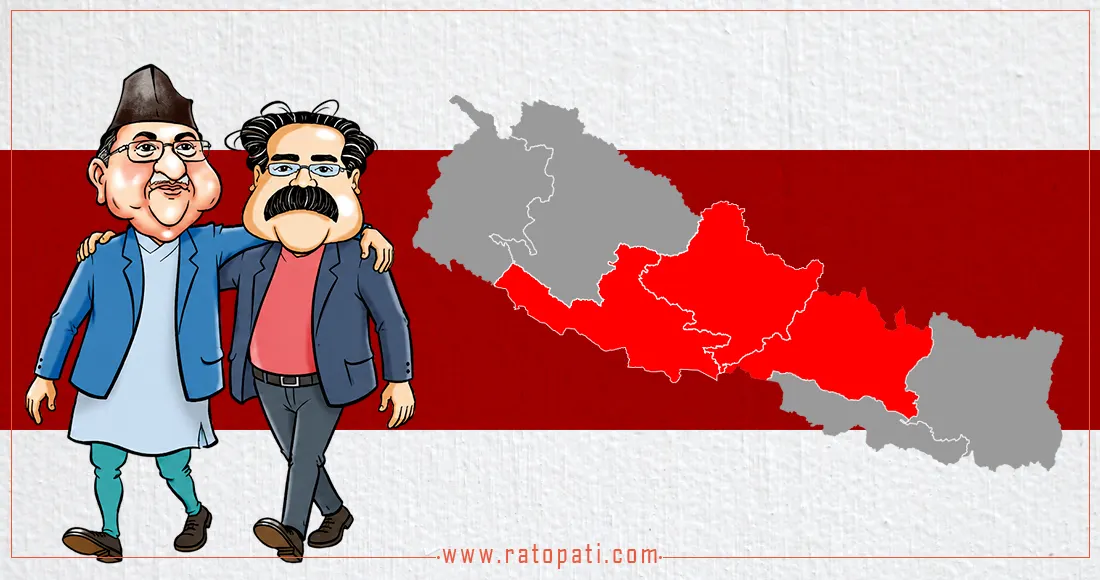
Kathmandu. Twelve days have passed since the three-point agreement between the CPN-UML and the Communist Party of Nepal (CPN) to cooperate in provincial governments, yet new governments have not been formed in most provinces. On August 10, an agreement was reached between UML Chairman KP Oli and CPN Coordinator Pushpa Kamal Dahal 'Prachanda' to share power in five provinces, and to consult with other parties to form governments in the remaining Madhesh and Gandaki provinces. According to the agreement, UML will lead the governments in Koshi, Bagmati, and Lumbini. It was agreed that the CPN would lead in Karnali and Sudurpashchim. While a Chief Minister has been appointed in Karnali as per the agreement, the cabinet expansion has not yet occurred. In the remaining provinces, the process of government formation has not moved forward according to the new coalition. In provinces where they were supposed to lead the government, internal disputes have erupted within the UML over the Chief Minister position. In Bagmati, Lumbini, and Gandaki, governments cannot be formed without the support of smaller parties considered decisive forces. Although a stable government of the leftists is assured in Koshi Province, a dispute has arisen as UML Chairman Oli seeks to replace the current Chief Minister Hikmat Karki with Tilkumar Menyangbo, elected from Taplejung Province Assembly-1. In Bagmati, Oli has increased his efforts to make Kiran Thapa the Chief Minister, blocking parliamentary party leader Jagannath Thapaliya, which has caused controversy. Thapaliya collapsed on August 4 during a discussion with Oli on this very issue. Meanwhile, in Koshi Province, a consensus has been reached to continue with the current Chief Minister Karki for the time being amidst the dispute over leadership change. However, for the formation of provincial governments, a leftist government in Bagmati, Gandaki, and Lumbini provinces is not possible unless the internal dispute within UML is resolved or the CPN provides support. In the 104-member Bagmati Provincial Assembly, at least 53 lawmakers are required for a majority. Here, UML has 25 and CPN has 26, totaling 51 lawmakers. The Deputy Speaker, Apsara Chapagain, cannot vote as she is in the role of Speaker. Three more seats are needed for a majority. To secure a majority, UML needs the support of either the Nepal Majdoor Kisan Party or the Rastriya Prajatantra Party. In the province, RPP has 12 seats, NMKP has 3, and Hamro Nepali Party has 2 seats. NMKP is known for being a perpetual opposition. Hamro Nepali Party has already been included in the government by Bagmati Chief Minister Indrabahadur Baniyan. In this situation, RPP has become decisive for the formation of a new government here. RPP has instructed its provincial leaders not to support any party without a central decision. The game has reached an interesting turn as the minority Chief Minister Indrabahadur Baniyan appointed Ha.Ne.Pa. lawmaker Shailendraman Bajracharya as a minister to prevent the transfer of power to the leftist alliance. NMKP has clarified that it will not participate in the game of forming and breaking governments. In Sudurpashchim Province, led by the CPN, the provincial assembly arithmetic is favorable for the leftist alliance. However, within the CPN, there are three factions with different backgrounds: the former Maoist Center, the Unified Socialist, and the Nagarik Unmukti Party. The Nagarik Unmukti Party has made it clear that it wants respect and a fair share according to its former strength. In this province, CPN parliamentary party leader Khagraj Bhatta is preparing to become the Chief Minister. The CPN has 22 seats and the UML has 11 seats in the Provincial Assembly. In the current 52-member Provincial Assembly, at least 27 lawmakers' support is required for a majority. The formation of a leftist government is most complex in Gandaki Province. In the current 59-member Provincial Assembly, at least 30 votes are required for a majority. Here, UML has 22 and CPN has 8, which would form a majority, but since the Speaker cannot vote, the leftist alliance needs one more seat. For that, the support of RPP or independent lawmaker Phaneendra Devkota is needed. RPP and the independent lawmaker appear decisive in this province. In Lumbini Province, led by UML, it appears that a comfortable majority will not be achieved for government formation. Currently, in the 83-member Lumbini Provincial Assembly, 42 votes are required for a majority. Here, UML has 29 and CPN has 13 seats. Since the Speaker of the Provincial Assembly is from the CPN, one more seat is needed. For that, UML needs the support of either JSP Nepal, RPP, Janamat Party, or Rastriya Janamorcha. JSP Nepal has 5 seats, RPP has four, Janamat Party has three, and RPP has one seat. CPN leader Sudarshan Baral informed that discussions are ongoing with JSP Nepal to secure the majority. In Madhesh Province, forming a leftist government also appears difficult. Since the 2079 elections, the government of Madhesh Province has been unstable. In this province, Saroj Kumar Yadav of JSP Nepal, Satish Kumar Singh of Janamat Party, Jitendra Prasad Sonal of LSP Nepal, and Saroj Kumar Yadav of UML have already served as Chief Minister. Currently, Krishna Prasad Yadav of the Congress is the Chief Minister with the support of UML and CPN. In the current 103-member Madhesh Provincial Assembly, at least 52 lawmakers' support is required for a majority. In this province, UML has 24 and CPN has 15, totaling 39 seats. To form a government led by the leftists, the support of either JSP Nepal, Janamat Party, Nepal Federal Socialist Party, and RPP is necessary. JSP Nepal has 28 seats, Janamat Party has 12, and others have 2 seats. In Lumbini Province, led by UML, it appears that a comfortable majority will be achieved for government formation. Currently, in the 83-member Lumbini Provincial Assembly, at least 42 lawmakers' support is required for a majority. Here, UML has 29 and CPN has 13 seats. In Karnali Province, allocated to the CPN, although Mangal Kumar Shahi has been appointed Chief Minister, the cabinet could not be formed even after a week. In terms of numbers, the leftists have a majority in this province. In Koshi Province, the central decision to continue Karki has resolved the immediate problem. In this province, UML and CPN alone have a clear majority to form the government.
Read full story at source (english.ratopati.com)