
US Wildfires Become Part of Daily Life Amidst Climate Change
english.ratopati.com · Sun Aug 09 08:18:10 GMT 2026
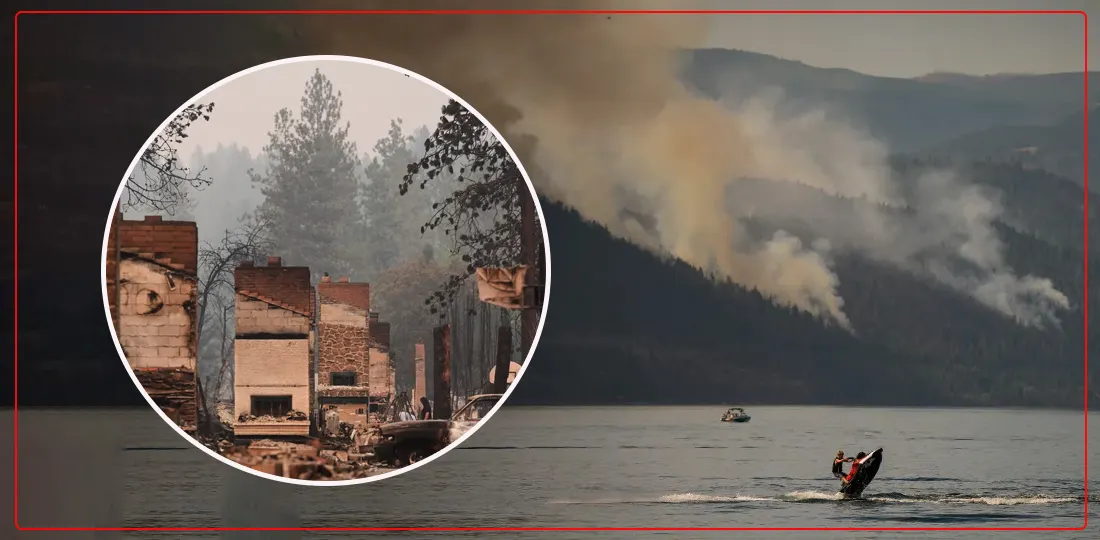
Destructive wildfires have become a part of daily life in many parts of America. Americans are adapting to a warming planet, and rapidly increasing weather events are becoming commonplace. This summer, wildfires notably destroyed communities in Spokane, Washington State. Tens of thousands of people had to evacuate to safety. Similarly, many parts of the western United States were affected by wildfires. Communities in states like Utah and Colorado were burnt down. On top of that, terrifying scenes from Europe and smoke spreading from Canada to the US have further aggravated the situation. US President Donald Trump has called climate change a 'hoax'. He has withdrawn the US from international obligations to address this problem. He has also significantly cut efforts to mitigate the effects of climate change domestically. Last month, Trump even questioned whether Canada should compensate the US for the smoke from Canada making American air 'toxic', but the US Environmental Protection Agency (EPA) under the Trump administration has almost completely dismantled an institution researching the effects of wildfire smoke on humans. Similarly, due to budget cuts by the Trump administration, the National Oceanic and Atmospheric Administration (NOAA) has stopped collecting data on damages caused by disasters like wildfires and other weather events related to climate change. According to a non-profit organization, the wildfires in Los Angeles alone since the beginning of Trump's second term have caused an estimated $63 billion in damages. The wildfire menace is severe. In recent years, homes have been destroyed and people displaced in states including Texas, Tennessee, Florida, California, and Hawaii. Every year, excessive wildfires spread in the forest areas of the western United States. Trump has also initiated the process of restructuring various government agencies that deploy firefighters to control wildfires in American territories and establish a new US Wildland Firefighting Service. However, Congress has refused to allocate budget for the new agency as envisioned by the Trump administration. Despite ongoing political differences in Washington D.C., the spread of wildfires has not stopped. What is the wildfire season like this year? This year, the wildfire situation is above average almost everywhere. By the beginning of August, the area burned by wildfires across the US is about 50% more than the average of the last 10 years. But it is important to note that the situation in the last 10 years was also worse than normal. If the current situation is compared to that of two decades ago, the baseline for wildfires has increased by about 50%. Therefore, the area burned by wildfires is continuously increasing. This problem is not limited to the US. The situation is even worse elsewhere. For example, in Canada, the area burned by wildfires this year is significantly higher than average. In each of the last four years, Canada has been among the top four years in terms of area burned by wildfires. Now it has become an almost annual occurrence. The situation is similar in Europe. Every year, wildfires occur in some part of Europe, and every year more wildfires are seen than before. Last year, Greece and Italy experienced major wildfires. This year, Spain, France, and the UK have been affected. New temperature records are being set every summer in almost all parts of Europe. Currently, Oregon and Washington are leading in terms of the number of major wildfires in the US. California is not at the forefront right now, but the situation may not take long to change. For many years, California and Colorado have been at the forefront. The exact location of wildfires may change every year, but overall, the burned area, the number of wildfires, and other such indicators are continuously increasing. The wildfire season now seems like it will never end. Therefore, it is not appropriate to consider some parts of California lucky in the current situation. The wildfire season there usually starts later in the year. Major windstorms occur in autumn. Intense wind events can dry out vegetation and other flammable materials significantly. There is also very little rain during the summer in California. Therefore, the environment becomes extremely dry during this time. When strong winds start blowing in autumn, major wildfires spread there. Oregon and Washington are generally not such dry and hot regions. Many places near the Pacific Ocean there do not even have air conditioning systems in homes. But when the temperature reaches 90 or 100 degrees Fahrenheit for many consecutive days, which has not happened in the past, the situation changes. When new temperature records are seen, the possibility of wildfires becomes very high. How responsible is climate change for wildfires? Humans have always caused wildfires, sometimes intentionally and mostly accidentally. Fires can spread from campfires. Wildfires can start even when starting a car in dry grasslands. The ratio of human-caused and natural wildfires has not changed much in recent years. Therefore, saying 'wildfires occurred in Spokane due to climate change' is not correct. Such a claim is false. However, climate change creates a favorable environment for wildfires to spread in that region. The matter is simple. The drier an object is, the more likely it is to burn. The hotter a place is, the drier it becomes. Climate change is altering the atmosphere's capacity to absorb water. This accelerates evaporation and reduces water levels. Reservoirs in the western US, such as Lake Mead and Lake Powell, have reached their lowest water levels ever. Climate change is also absorbing water from trees, shrubs, and forests. This makes the vegetation drier and more brittle. But there is another aspect to this. If a region becomes continuously dry, eventually some of those regions may turn into deserts, and after a long time, there may not be enough vegetation to burn. But the main problem is the seasonal fluctuations currently being observed. This is particularly evident in California, where one year there is excessive rainfall, and the next year it is extremely dry. Natural climate systems like El Niño and La Niña can also play a role in years with heavy rainfall or drought. Ironically, climate change can exacerbate extreme rainfall events. As the climate warms, warmer air can hold more water vapor. Therefore, in some years, there can be lush growth and abundant vegetation. Then, if the following year is the hottest and driest year ever, it can lead to devastating wildfires. This is what is happening now. The same has happened in Europe. Europe was very wet in winter, and then this summer has become the hottest ever. This has also created a very bad situation for wildfires. Why are wildfires devastating even in wet areas? No place is completely safe from wildfires. Wildfires can occur even in areas with forests and natural wildlands. A very devastating wildfire occurred in Gatlinburg, southeastern US, a few years ago. That incident made many people realize that this problem is not limited to the West Coast. Wildfire incidents are relatively less common in the Great Lakes region and some inland areas of the northeastern US. Florida receives a lot of rain. But even if the rain stops for a short time, it dries out very quickly due to the extreme heat there. Similarly, Florida experiences more lightning strikes per square mile than any other place in the US. Lightning is one of the main causes of wildfires. In Florida, a few weeks without rain, extreme heat, and then thunderstorms are enough to ignite dozens of wildfires. The risk of wildfires can increase in habitable areas. In the US alone, millions of people live in the 'wildland-urban interface', the area between forests and urban settlements. They prefer to live in such environments. Such areas are called interface zones. As cities expand, settlements have been built in areas that were previously forests or natural wildlands. These are places people like to live. Living on the coast is also like this. Although the risk of hurricanes is high, people prefer to live there for other obvious reasons. But by doing so, human settlements connect with nature, and nature naturally burns. The natural process of wildfires in forests is actually beneficial. Therefore, prescribed burns are carried out to keep forests healthy. This keeps the forest healthy and removes excess vegetation and flammable materials. However, it is not always possible to manage forests in areas between forests and urban settlements to the required level. Because even prescribed burns are ultimately fire and risk. People do not like such fires. They do not like beautiful summer days being covered in smoke. Therefore, there is always a conflict between forest management and the wishes of local residents. Moreover, prescribed burns cannot be carried out when the situation is risky. Days with sufficient moisture in the forest and low wildfire risk are needed. But in most years, such days are few. Therefore, this task is becoming more difficult. Governments may have to do more such prescribed fire management in the future. What can homeowners do? Fire management can be done during the settlement development phase itself. Homes can be built to withstand fire risk, and open spaces can be created to prevent the natural spread of fire. Homeowners can do many things at their own level, such as not using highly flammable construction materials and managing gardens and vegetation around the house in a way that is not sensitive to wildfires. This can increase the chances of the house or the entire settlement surviving wildfires. The most important thing is not to build houses directly adjacent to forests. There should be natural open spaces between the house and the forest, and there should also be open spaces between houses. If a fire starts in one house in a settlement, the fire can spread very quickly from one house to another, and then to another house, especially when the wind is blowing. The wind carries fire embers very effectively. Even a few embers falling on the roof can cause a house to burn down in a short time. What are climate scientists and firefighters saying? According to climate scientists and firefighters, such situations will become more frequent. The area burned by wildfires will continue to increase. A major reason for this is the lengthening of the wildfire season. Wildfires start earlier than before and last longer. Let's look at Canada as an example. In the past, wildfires did not start much until June or July, because snow would still remain on the ground until then. It took many months for the ground and vegetation to become dry and hot. But now, changes are happening from both directions. In many years, there is little snow, so the snow melts quickly, and vegetation starts to appear. Vegetation also sprouts early and then dries out quickly. On the other hand, it takes a long time for snow to fall again, for rain to occur, and for the temperature to cool down. This trend is expected to continue in the coming days, especially in northern regions like Canada, Europe, and Russia, where the most extensive and devastating wildfires have been observed. In the past, nights were an important time for firefighters to control wildfires. In case of very intense wildfires, they would retreat during the day. But after nightfall, they would actively try to control the fire and manage to bring it under control before the temperature rises and the wind intensifies during the day. This is rarely the case now. Just as the wildfire season has expanded to almost year-round, the 'day' for wildfire control has now become 24 hours. Firefighters have less time and fewer opportunities than before to effectively control wildfires or prevent their spread. This is why wildfires are sometimes spreading at an extraordinary speed even at night. (Analysis by CNN journalist Zachary B. Wolf in collaboration with CNN Chief Meteorologist and Chief of Climate Crisis Issues, Brandon Miller, on 'This Year's Wildfires, Overall Wildfire Situation, Potential Future Impacts, and the Role of Communities')
Read full story at source (english.ratopati.com)