
Parliamentary Committee Suggests Gas Cylinder Tracking System to Curb Artificial Shortages
english.ratopati.com · Tue Aug 04 09:41:14 GMT 2026
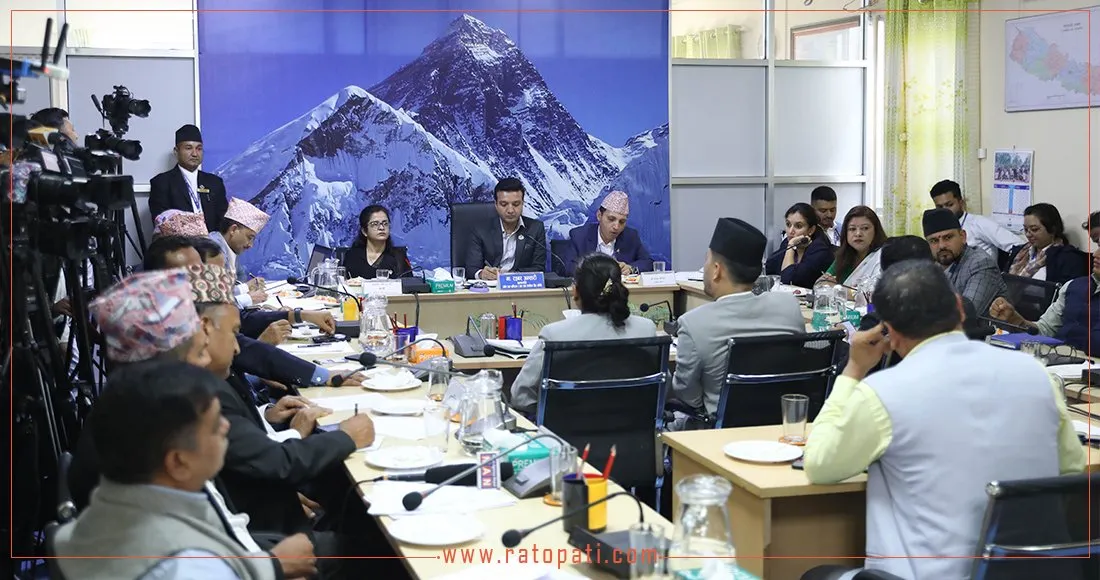
Kathmandu. Lawmakers have suggested the government implement a 'tracking' system by collecting data on gas cylinders to prevent artificial shortages of gas in the market. The suggestion was made during a meeting of the Industry, Commerce, and Consumer Welfare Committee of the House of Representatives. Lawmakers stated that despite sufficient gas supply, artificial shortages of cooking LP gas are occurring in the market due to the government's managerial failures. They pointed out the contradiction between the government's claim of adequate supply and the observed shortage in the market. They urged the government to make significant improvements in the distribution system, data management, monitoring, and legal framework. Arvind Sah, a lawmaker from the Rastriya Swatantra Party (RSP), stated that the government itself is uncertain about the actual demand for gas. Highlighting serious weaknesses in data management, he urged for the collection of accurate data on gas consumption. He remarked that the shortage in the market, even when more gas than needed enters, is a result of management weaknesses and apathy. He said, 'Even now, we are uncertain about our actual gas consumption. Sometimes we say 46-47 thousand metric tons, sometimes we say it's 30, 32, or even 28 thousand. What is this exactly? This is a difference of more than one and a half times, isn't it?' Pointing out the incorrect data, he added, 'Therefore, this data is wrong, and I believe we need to work on it. We need to determine our exact needs and also look at the conditions of maximum and minimum consumption. If we have brought 60 thousand metric tons, why is there a shortage even after bringing more than needed?' He emphasized that this is a result of extreme weakness and apathy in management and that the 'it is what it is' attitude must end. RSP lawmaker Sirjana Shrestha stated that there is no integrated digital data regarding gas supply, cylinder status, and distribution. She demanded the immediate implementation of a digital data management system. She questioned how quality testing is being conducted after the testing laboratory in Teku was damaged. She also mentioned the weak information system of the Nepal Oil Corporation and suggested making information on distribution, availability, and supply public through digital means. She also urged for arrangements to distribute gas from all depots. She said, 'If we don't even have data on how much gas has arrived and how many cylinders our distributors have, then we must make a decision on data management. This data needs to be managed digitally.' She added that it is necessary to digitally maintain data on which depot has which type of cylinder and how many cylinders are in each household, stating, 'This data will be useful for future generations as well. Let's decide today how to proceed with data digitalization.' Regarding the quality testing laboratory, she said, 'There is talk of 20 percent sediment in gas. If the testing laboratory in Teku is damaged, do we have a laboratory now? If not, when will it arrive? Because if there is no laboratory, who is measuring the quality?' She stated that consumers are being cheated as half of it is sediment and half is gas. She asked, 'If we cannot manage that, then what are we here for? How can we build this laboratory, and by when?' Another RSP lawmaker, Prakash Pathak, said that the significant difference between the data of the Nepal Oil Corporation, industrialists, and the government has created confusion. He stated that although the corporation claims that gas equivalent to the monthly demand is being imported, consumers are not getting gas. He attributed the failure to government monitoring, management, and distribution systems. He urged for effective regulation to be implemented immediately, mentioning the lack of laws governing petroleum products. He said, 'When I go out, the seller says there is no gas. Citizens or consumers are facing hardship. Your data has also created confusion in some matters.' He stated that the Nepal Oil Corporation reported importing 49,000 metric tons of gas in July's data, while the government's claim is that the monthly demand is 47 to 48,000 metric tons. He questioned, 'Why is this discrepancy not aligning? Are we ourselves showing irresponsibility?' He stated that even though there isn't a huge difference between demand and supply, the situation where consumers are not getting gas needs to be addressed and moved forward. He emphasized that discussions should now focus on making laws, as there are no laws to regulate petroleum products. Ganga Devi Shrestha, a lawmaker from the CPN (UML), said that although the government claims to have sufficient gas stock, consumers are forced to wait in long queues due to the unavailability of gas. She stated that there is a gap between the government's claims and reality. She suggested reusing the option of distributing half cylinders as an immediate measure to ease distribution. She emphasized solving the immediate problems of consumers before collecting data. Chhitelj Thbe, also a lawmaker from UML, said that gas shortages have been recurring for years and that a sustainable solution, rather than a temporary one, should be sought. He described it as ironic that the state, which encourages citizens to use gas, cannot ensure a regular supply, and suggested opening up options for providing cylinders of various sizes. He said that everyone should unite to free the public from hardships. He said, 'This is not a problem that has arisen today. We have seen it many times. Even when we were leading the youth, we went to the Oil Corporation many times to protest.' Recalling protesting many times about gas issues, he added, 'So, this is not a one-time problem; we all know it. My question and attention are: when will we find a permanent and sustainable solution?' He stated that the purchasing power of poor Nepalis is not such that they can buy 4-5 cylinders and stock them at home, but due to the shortage, citizens are forced to stock them even by taking loans. He also said that keeping many cylinders at home is not safe and that this stocking is causing problems in the market. He said, 'Open up options for 7 kg and 15 kg, and also for 1 kg. Don't go for the half, full option. Make it easy for the public by providing all kinds of options.' RSP lawmaker Badan Bhandari said that monitoring is often lax. He accused depots of being prepared in advance by leaking information before inspections. He stated that inspections based on prior notice do not show the real situation and suggested implementing a tracking system for gas cylinders. He said that the shortage in distribution, despite sufficient imports, is a management weakness. Nepali Congress lawmaker Kalibahadur Sahukar demanded information on why gas depots have not yet been established in Karnali Province. He stated that there is a significant difference in the usage period between 7.1 and 14.2 kg cylinders and that the corporation must provide an explanation. He also demanded a clear answer from the government regarding the issue of sediment in gas. He also drew the government's attention to the situation where public transport fares do not decrease even when fuel prices decrease. RSP lawmaker Runju Neupane said that gas shops in Kathmandu are closed, and consumers are forced to carry cylinders and search for gas. She urged an end to the tendency of blaming consumers for gas shortages. She also emphasized promoting alternative energy along with legal reforms. RSP lawmaker Buddhiprasad Panta said that despite repeated discussions in the committee, the problem has not been resolved. He urged the officials of the concerned bodies to resign if they are unable to work. He also questioned the situation where consumers do not receive relief when prices decrease in the international market. RSP lawmaker Shom Sharma shared her experience of her own industry being affected due to gas shortages and accused political interference in distribution. She suggested that keeping digital records of each cylinder is necessary, as the lack of scientific record-keeping of cylinders increases artificial shortages. In the meeting, lawmakers drew the government's attention to the fact that implementing a tracking system by collecting data on gas cylinders would prevent artificial gas shortages. They stated that the current distribution system, data management, and monitoring are slow. Lawmakers urged the government to take immediate corrective measures and make legal and institutional arrangements for long-term solutions.
Read full story at source (english.ratopati.com)