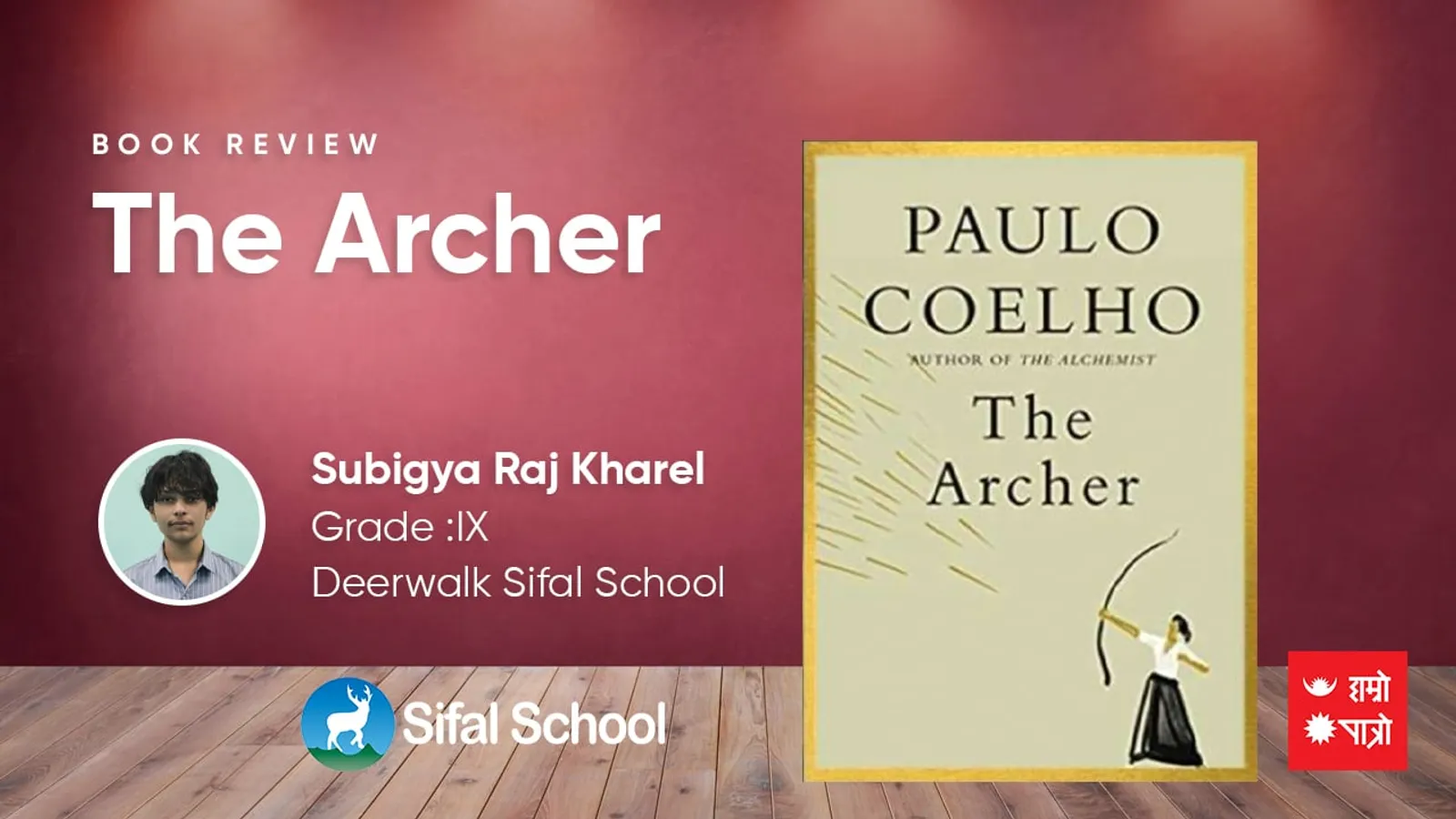
Recently we had the opportunity to read the famous “The Alchemist” by Brazilian author Paulo Coelho. Having tasted the pieces of Coelho before, I was overjoyed seeing the name written on the front page of yet another book. However, despite sharing the same author, the two books differ significantly, especially in the depth of their narratives and the way illustrations are used to convey meaning.
Born in 1947 in Rio De Janeiro, Coelho gained international recognition with his book “The Alchemist”. In The Archer, Coelho continues this approach by using a brief, almost fable-like narrative to convey lessons about discipline, balance, patience, and inner strength. His writing is often minimal in language but rich in metaphor, aiming to make complex life ideas accessible to a wide audience.
The plot itself is quite small. In fact, when I first held this book in my hand, I was shocked by how little is written on each page, and the sheer amount of illustrations in a book given to high-school students. It was quite a pleasant contrast to the long and plot heavy books that we usually get. I genuinely thought that the language department has mistakenly given us books meant for middle-schoolers, or even elementary school students.
Having gone through the book now, what was once a major critique for me has turned into the most remarkable thing about this book. I realized that what makes a book great is not about how many pages the plot can be spread upon, but rather how much the author can convey, with the littlest number of pages possible.
I was truly amazed by the number of ways this book can be interpreted, simply analyzing it to be a guide to the material weapon of bow and arrow, or philosophically, or even spiritually, religiously, the plot itself focuses on a man named Tetsuya who had achieved great glory for his renowned archery, but now in retirement, as a carpenter. When a young man named Nicholas challenges him, Tetsuya reluctantly demonstrates his skill, which was for years hidden.
Tetsuya becomes somewhat of a “mentor” to the boy and gives knowledge regarding subjects such as the way to hold the bow, the way to hold the arrow, the perfection of aim, the respect for targets, the concentration required of the weapon-wielder etc. A large majority of the book covers these teachings, which was quite annoying for me at first.
I thought, “Why do I need to learn about archery? I clearly have no intention to become an ancient warrior.”, but slowly, I realized that the reason for including these teachings in the book was not for filler, but rather to provide life lessons to the readers, through the unconventional means of bow and arrow.
You might think that archery would be of no interest to, say, a baker or a farmer, but I can assure you that they will introduce whatever they see into what they do. You will do the same: you will learn from the good baker how to use your hands and how to get the right mix of ingredients. You will learn from the farmer to have patience, to work hard, to respect the seasons, and not to curse the storms, because it would be a waste of time.
-Page 24, Allies
In modern times, every person regards their profession as the supreme, the most difficult, the most important to society. Lawyers argue with scientists about which profession is greater, delving into these meaningless conflicts competing to satisfy their own egos. In a world like this, Page 24 of this book provides a very different perspective, which I for one enjoyed. In the quote above extracted directly from the book, Tetsuya is explaining to the boy how an archer should learn from bakers or farmers and vice versa.
Now, of course, this logic does not apply to archers, bakers and farmers. Expanding on my example of lawyers and scientists, a lawyer could learn precision and clarity from a scientist’s methodical approach to evidence, while a scientist could learn ethical responsibility and structured argumentation from legal reasoning. Rather than competing over whose profession is more important, both benefit from recognizing that discipline, patience, and critical thinking are transferable skills. Coelho’s message challenges the modern obsession with professional superiority and instead promotes mutual respect.
Through this idea, the bow and arrow cease to be symbols of combat and instead become representations of transferable discipline, reinforcing Coelho’s belief that wisdom is not confined to any single craft.
“When you look at the target, do not concentrate on that alone, but on everything going around it, because the arrow, when it is shot, will encounter factors you failed to take into account like wind, weight, and distance.”
-Page 46, The Target
Surprisingly, this book was not my first experience on getting lessons about the bow and arrow; the first time was when I watched a television series about the Hindu Epic ‘Mahabharata’. One of its central characters, Arjuna, is portrayed as the greatest archer of his time, not merely because of his technical skill, but because of his discipline, focus, and moral awareness. Trained under Dronacharya, Arjuna’s mastery of archery is consistently linked to inner control rather than brute strength, establishing the bow and arrow as symbols of concentration and responsibility rather than instruments of destruction.
Throughout the first 45 pages of The Archer, many of the lessons echoed Arjuna’s philosophy so closely that the resemblance felt almost uncanny. At one point, it even seemed plausible that Coelho may have drawn inspiration from the epic. However, the quotation from page 46 challenges this assumption. In a well known episode from the Mahabharata, Dronacharya tests his students by asking them to aim at a bird perched on a tree. While others describe the bird, its surroundings, or the branches, Arjuna alone succeeds by stating that he can see only the bird’s eye.
This moment highlights a clear philosophical divergence between the two works and contrasts the characters of Arjuna and Tetsuya. While the great sage Dronacharya believed that an archer should focus exclusively on the target, and nothing else around it, this book provides a fresh perspective that the archer should not remain obsessed with the target; but rather pay attention to all the affecting factors of the arrow’s trajectory such as wind and distance. This contrast suggests that where Arjuna’s discipline demands the exclusion of all distractions, Tetsuya’s mastery relies on balance and adaptability.
I would strongly recommend The Archer to readers who appreciate reflective and idea-driven literature, particularly students navigating academic pressure and competitive environments. Although its simplicity may initially appear misleading, the book offers insights that extend far beyond its length, making it a meaningful and accessible read.
Name: Subigya Raj Kharel
Grade: IX
Deerwalk sifal school
