
Devastating Flood Causes Significant Damage to Nepal's Economy and Infrastructure
english.ratopati.com · Wed Sep 09 11:15:00 GMT 2026
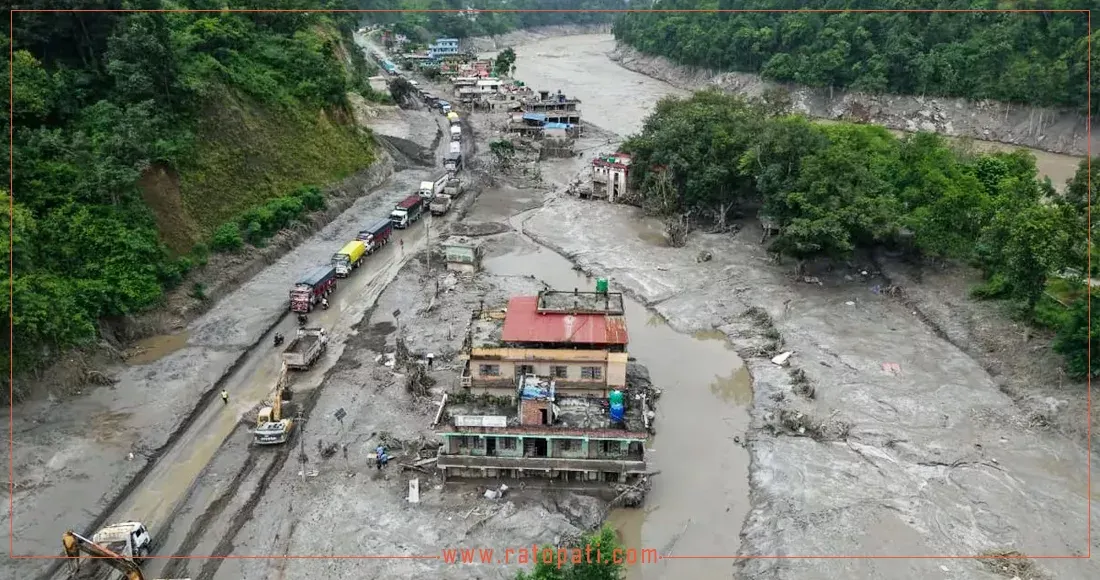
Kathmandu. The devastating flood in the Bhote Koshi and Trishuli rivers on the 10th of Bhadra has caused great damage to life and property. The flood washed away all settlements from the customs border to the Bhote Koshi and Trishuli corridor. The flood has not only destroyed physical structures but has also devastated the backbone of the river corridor, considered the most active lifeline of the country's economy. Preliminary data indicates that the physical and economic damage caused by the flood is considered the largest and most serious since the devastating earthquake of 2072 BS. According to information provided by Finance Minister Dr. Swarnim Wagle in various forums, the preliminary estimate of the loss due to the flood is around 7 to 8 kharba rupees. According to Finance Minister Wagle, a loss of 7 to 8 kharba rupees has affected about 13 percent of Nepal's Gross Domestic Product (GDP). According to economic experts, the flood has caused damage that will further affect the economy, which has been sluggish since the earthquake. The flood has also caused significant human casualties, not just physical damage. A large number of skilled technicians from hydropower projects, experienced tour guides, and local entrepreneurs are missing in the flood. Some have died. Energy and Physical Infrastructure in 'Blackout' The Bhote Koshi-Trishuli corridor, considered the backbone of Nepal's energy security, has been completely destroyed in 11 hydropower projects. These projects, with a capacity of 783 megawatts, were partly operational and partly under construction. Similarly, transmission lines and substation lines built for electricity supply after production have also been damaged. This damage has put a large investment at risk in Nepal's energy sector. In terms of infrastructure, the complete washing away of 55 kilometers of road and 37 motorable bridges has not only disconnected Rasuwa and Nuwakot but also closed the Rasuwagadhi border crossing, considered the lifeline to China. The revenue collected from this border crossing, amounting to millions, is also likely to be affected. With the closure of the Rasuwagadhi border, there is a compulsion to divert trade with China to the geographically difficult Kerung border. Businessmen say that since the Kerung border is geographically distant, the increase in transportation costs will lead to price hikes in the market. The situation in the tourism sector is even more dire. According to the Ministry of Culture, Tourism, and Civil Aviation, the damage to the tourism sector alone is around 50 billion rupees. World-famous trekking routes like Langtang and Gosainkunda have been devastated, and 142 hotels and 57 restaurants along the riverbanks have been completely wiped out by the flood. According to the Nepal Tourism Board, the main route for tourists going to Kailash Mansarovar is also closed, cutting off a major source of economic earnings. Former Vice-Chairman of the National Planning Commission, Prof. Dr. Shivaraj Adhikari, states that the Bhote Koshi flood has added serious challenges to the goals of the 16th periodic plan and the implementation of the current fiscal year's budget. He says that the flood has reached a stage where it will change the cycle of the country's economy. He adds that the plans and budget formulated by the government will also need to be revised. Adhikari states that it is certain that the disruption of the supply chain will lead to high price increases and a significant decline in revenue collection. According to him, to revive the struggling economy, the government needs to move beyond traditional rescue and relief and adopt a strong and safe recovery strategy. Similarly, former member of the Planning Commission, Dr. Ramesh Poudel, says that the flood of Bhadra 10 is a harsh lesson for Nepal. He believes that the government needs to adopt a strong reconstruction and preparedness strategy now. He states that such disasters caused by climate change will repeatedly destabilize the country's economy. Strategic Plan for Economic Recovery After Flood The government has prepared a strategic plan to revitalize the Nepali economy, which has been weakened by a long period of economic recession and the recent severe flood. Finance Minister Dr. Swarnim Wagle said that since the flood caused damage of over 8 kharba rupees, a separate strategic plan is being implemented to revitalize it. He informed that the government has prepared a clear roadmap to bring Nepal's economy out of crisis. A Business Recovery Package has been passed by the Council of Ministers to provide relief to small and large businesses in the flood-affected areas. Finance Minister Wagle is confident that this will help struggling industrialists and businessmen to rise again. The government has introduced a special reform plan to organize and strengthen the stock market. The main objective is to keep investor morale high and make the capital market transparent and reliable, according to Finance Minister Wagle. Stating that the economy cannot be dynamic without the active participation of the private sector, the government has introduced packages for economic concessions and investment promotion. This is expected to bring new enthusiasm to the sluggish market. The government is coordinating with international financial institutions to mobilize the large investment required for reconstruction by assessing the exact damage caused by the disaster. The Finance Minister's plan is to focus foreign aid and grants on productive sectors. Finance Minister Dr. Wagle expressed confidence that although Nepal is at a challenging juncture, the economy will soon return to normalcy with the government's proper intervention and the support of the international community. 'We are committed not only to overcoming the crisis but also to improving the structure of the economy and moving towards sustainable development,' he said. Dr. Shivaraj Adhikari says - The development model itself is wrong (in his own words) The government is only looking at the physical damage to assess the loss caused by the flood. The potential economic loss if the flood had not occurred has not been assessed. While the pit has now appeared and the damage is being assessed, it has not been considered how the economy would have moved dynamically if the pit had not appeared. Therefore, the actual damage caused by the flood is much greater than estimated. There is a misconception that post-disaster reconstruction increases economic growth. A similar narrative was created after the earthquake, but it did not happen. Returning the economy to its pre-disaster state cannot be called economic growth. It requires great effort to bring it back to its previous state. That effort will only bring the economy back to its old point. It will not bring new growth, but when measured from the pit upwards, a percentage increase is seen, which can be a measurement error. Returning to the previous state will not contribute significantly to government revenue, but capital formation during reconstruction is expected to contribute somewhat to the growth of the next year. The unimaginable damage to infrastructure including hydropower due to floods and landslides has occurred. This unimaginable damage raises questions about the past development model. The development model of Nepal itself is seen as flawed and can be said to be so. Nepal's development model is extremely expensive and wrong. The government now needs to pay more attention to disaster prevention. Concentrating all hydropower projects in a single river basin (stream) is considered a misuse of natural resources. This is damage. We raised issues of climate change in small forums, but did not implement them in practice. Our development path itself is not wrong. The government must seriously review this. Development is no longer possible with the old economic model. The Bhote Koshi flood has taught us a further lesson that new approaches must be taken in infrastructure construction, keeping in mind climate change and potential disasters. Economist Dr. Ramesh Poudel says - The model of settlement development and infrastructure must be changed (in his own words) It is estimated that the Bhote Koshi flood has caused direct physical damage of more than 10 kharba rupees to the country's economy. Although the Finance Minister estimated the damage at 8 kharba based on estimates, the damage could be more than 10 kharba. The government has not yet collected the full details of the damage. The damage to livestock and the ecosystem has not even been accounted for. The government initially estimated a loss of 2 billion and later 8 billion. Therefore, it is still not certain. The government has been engaged in rescue operations so far. Therefore, considering the damage caused by the flood, it is likely to exceed 10 kharba directly and will give a serious blow to the economy. The method of assessing the current damage is very traditional and random. We do not have a system to keep accurate data on how much damage occurred in which village, which house, and how many animals died. Until our informal economy is transformed into a formal one, the actual damage cannot be calculated. Nepal is in a region of natural risk. There is a need to create a separate and permanent mechanism with full intactness for disaster management. The practice of the government only waking up when a disaster strikes, without prior preparation, is causing great human and physical damage. The capacity to rescue citizens trapped in the middle of rivers by helicopter, even in Kathmandu, was not available with past governments. There is a serious flaw in Nepal's infrastructure and settlement development model. For every development we have done, we have caused destruction. Most of our settlements are on riverbanks or in valleys within catchment areas. Settlements from Butwal, Ridi, Dolalghat, Gaighat to Tanahu are at risk. While building houses in the hills, there is the fear of landslides, and when going to the plains, there is the fear of floods and erosion. In future reconstruction, settlements and industries should be established only in safe places with a vision for the next 200 to 500 years. There is a need for long-term policy on where to establish settlements, where to open industries, and where to build infrastructure. Due to floods, landslides, and climate change, Nepal has had to pay a heavy price without its fault. We are suffering damage that Nepal did not cause. If this trend continues, the risk of seas submerging and our forests being destroyed and droughts occurring will increase. We need to create a mechanism that can effectively convey this message to the international community. Floods and landslides have pushed the country's economic growth into a negative state for the immediate term. This disaster has directly affected the Gross Domestic Product (GDP). Today, our growth is negative, but this will not last forever. We can also look at the example of Sri Lanka after the tsunami, where Sri Lanka's economic growth was good after the tsunami due to international aid and effective reconstruction. If we can increase economic activity in the remaining months and mobilize aid from donor agencies, we can quickly recover the economy and move it towards positive growth. However, this is a big challenge due to the government's current resources and capacity being insufficient.
स्रोतमा पूरा पढ्नुहोस् (english.ratopati.com)