
Nepal Enters Tunnel Era with Inauguration of Nagdhunga-Sisnekhola Tunnelway
english.ratopati.com · Tue Jul 28 06:08:48 GMT 2026
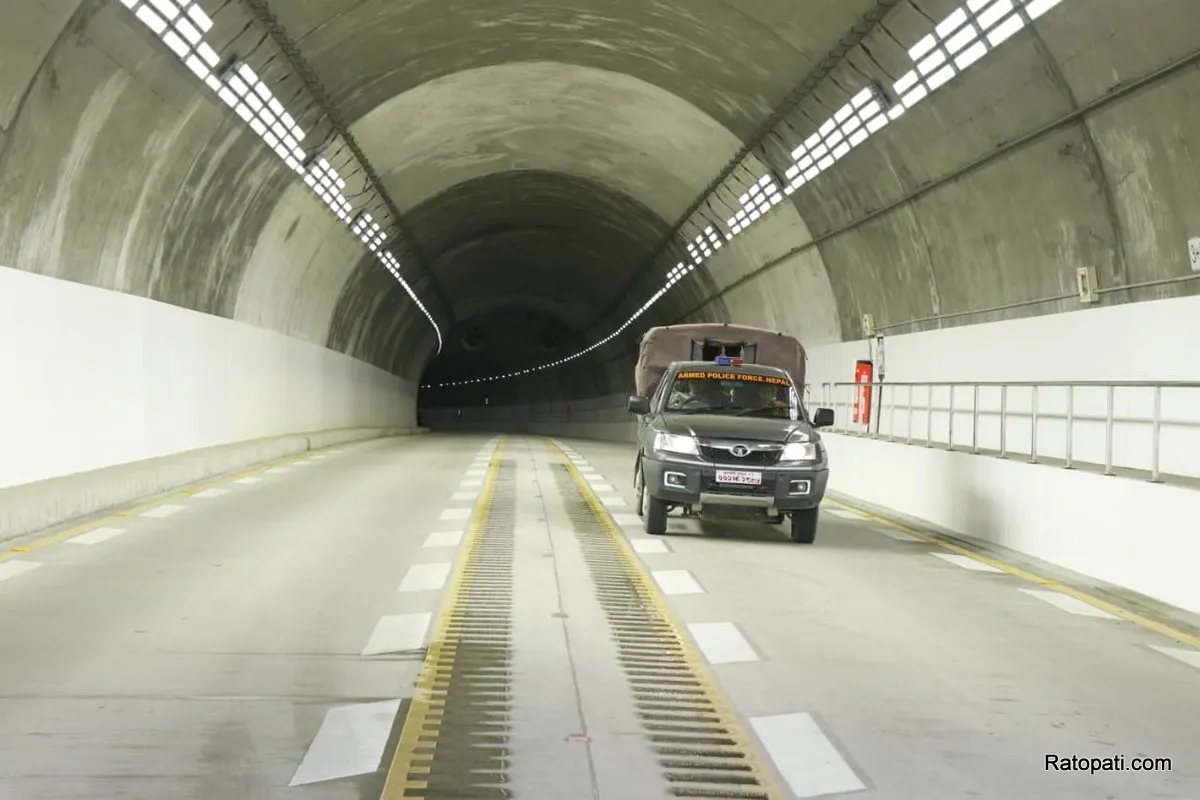
Kathmandu. A significant milestone in Nepal's transport infrastructure history, the Nagdhunga-Sisnekhola tunnelway has been formally inaugurated. After successfully completing 'operational' and 'maintenance' tests, this tunnelway was inaugurated on Monday in a ceremony. With this, the decades-old dream of the Nepali people to drive on a modern tunnelway has materialized. This project, being Nepal's first road tunnelway, has officially ushered the country into the era of tunnelways. Transport entrepreneurs and infrastructure experts have described this as a major achievement for Nepal's road transport sector.Expressing happiness over the inauguration of the Nagdhunga tunnelway, Chairman of the Federation of Nepal Transport Entrepreneurs, Punyaprasad Sitoula, stated that the government should expedite the construction of other under-construction tunnelways across the country. He expressed confidence that this project will save time and reduce the risk of potential accidents on the difficult Nagdhunga road section.However, he expressed dissatisfaction with the fees set for public and cargo vehicles for using the tunnelway. He urged the government to reconsider the fees determined for public passenger and cargo vehicles using the tunnelway.He said, 'We are happy with the inauguration of the Nagdhunga tunnelway. The government should also fast-track the construction of other under-construction tunnelways across the country.' He further added, 'I urge a reconsideration of the fees to be paid by public passenger and cargo vehicles operating in the tunnelway.' He requested the government to manage the finances in a way that does not affect the tunnelway operations and public transport.According to the Director General of the Department of Roads, Dr. Bijay Jaisi, the tunnelway will currently be in a trial phase for a few days. He clarified that no fees will be charged until the tunnelway is fully open to the general public. Stating that the final technical test (mock drill) of the tunnelway is pending, he said that the tunnelway will be operational for all types of vehicles within a few days. He informed that the lifespan of the tunnelway is one hundred years.Director General Jaisi said, 'This tunnelway has a design life of one hundred years. If it is operated properly, it will last for this design life.' He further added, 'We have to do a little mock drill. After that, the tunnelway will be fully operational soon. We will not charge any fees until it is fully operational.'Secretary of the Ministry of Physical Infrastructure and Transport, Gopal Prasad Sigdel, stated that tunnelways are indispensable for safe and fast travel due to Nepal's geographical complexities. According to him, the 900-meter-long Siddhababa tunnelway, currently under construction, is also targeted to be operational within the current fiscal year.Clarifying the cost and fees for tunnelway operation, Secretary Sigdel said that the operational cost will be relatively high because 24-hour technical manpower presence is necessary inside the tunnel for security, monitoring, and maintaining air quality. He mentioned that costs can be reduced by operating many tunnelways through a single integrated management system in the future. He informed that the construction of six other tunnelways, including the Kathmandu-Terai Fast Track, is also progressing rapidly.Secretary Sigdel said, 'With the inauguration of this tunnelway, we have entered the era of tunnelways. We will make the 900-meter Siddhababa tunnelway, which is under construction, operational within this fiscal year.'He added, 'In a country with our geographical conditions, tunnels are indispensable. Tunnels are extremely necessary for saving time and reducing vehicle accidents.' He stated that the operational cost will be a bit expensive due to the need for 24-hour human presence, and the cost will decrease with a single management system once more tunnels are built in the future.According to the Department of Roads, cars and vans will have to pay a fee of 65 rupees when entering Kathmandu and 60 rupees when exiting. Minibuses, trucks, and tippers will have to pay a fee equivalent to 115 rupees when coming to Kathmandu and 80 rupees when exiting. Similarly, buses and trucks will have to pay a fee equivalent to 260 rupees when coming to Kathmandu and 200 rupees when exiting. Motorcycles, two-wheelers, three-wheelers, and pedestrians are prohibited from entering the tunnel for security reasons. Also, vehicles carrying flammable and explosive materials will not be allowed to use this route.The initial cost of this project, which was laid by the then Prime Minister KP Sharma Oli in November 2019 (Bikram Sambat 2076 BS), was estimated at around 22 billion rupees. However, due to geological problems encountered during construction, design modifications, and other technical reasons, its total cost has exceeded 27 billion rupees. Although challenging in terms of expenditure, this tunnelway has established a new standard in Nepal's modern infrastructure development.
स्रोतमा पूरा पढ्नुहोस् (english.ratopati.com)